Home
› How to Structure a Research Paper: Section-Wise Breakdown
How to Structure a Research Paper: Section-Wise Breakdown
Nilambar
March 14, 2026
How to Structure a Research Paper: Section-Wise Breakdown | Nilambar Khanal
🎓 Academic Writing Guide 2025
How to Structure
a Research Paper:
Section-Wise Breakdown
From title to references, every section of a research paper has a specific job. This guide walks you through each one in plain language, with reviewer tips, common mistakes to avoid, and practical examples.
1940sIMRaD format first appeared in medical journals
100%Top medical journals used IMRaD by 1985 (PMC)
150-300Ideal word count for an abstract
4-6Optimal keyword count per paper
60-70%Papers fail peer review due to structural weaknesses
Advertisement
A research paper is not just about what you found. It is about presenting what you found in a way that a reader, a reviewer, or an editor can trust, follow, and replicate. Structure is not a formality. It is the argument itself. When a reviewer opens your paper and cannot quickly locate your research question, your sample size, or your main finding, the rejection happens before they have even assessed your science. This guide fixes that problem, one section at a time.
The global standard for structuring original research across sciences, social sciences, and engineering
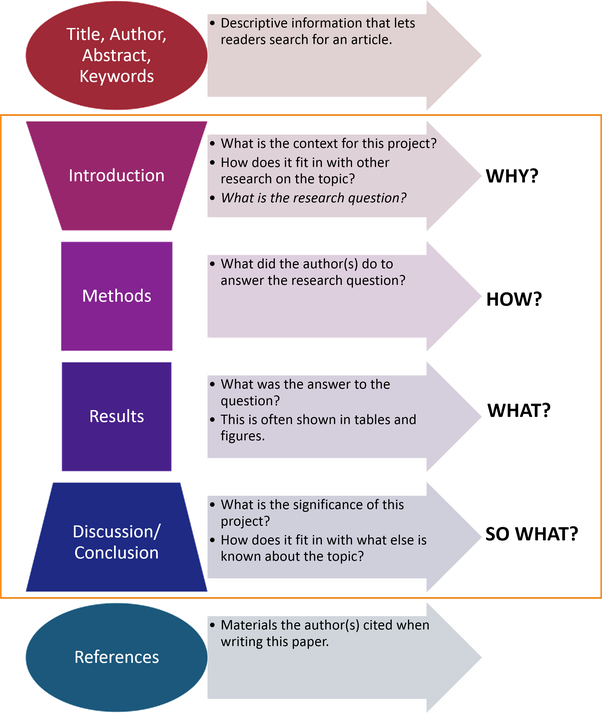
IMRaD stands for Introduction, Methods, Results, and Discussion. It is the most widely used structure for scientific papers and first became the majority format in top medical journals during the 1970s. By 1985, it was the only pattern in journals like JAMA, The Lancet, the British Medical Journal, and the New England Journal of Medicine, according to a landmark 50-year survey published in the Journal of the Medical Library Association (Sollaci and Pereira, 2004).
The reason it works is simple. It mirrors the scientific method itself. You ask a question (Introduction), you design and conduct your study (Methods), you observe what happened (Results), and you make sense of it (Discussion). When readers know the format, they can navigate directly to the part they need. When reviewers know the format, they can evaluate your work systematically. That makes your paper easier to accept.
The wine-glass model of IMRaD. The Introduction starts broad and narrows to your research question. Methods and Results are the narrow, specific middle. Discussion then expands back out to what your findings mean for the wider field. Source: Glasman-Deal (2010); Wikipedia IMRaD article.
All 9 Sections at a Glance: Purpose, Word Count and Key Question
Section
Core Purpose
Key Question It Answers
Typical Length
Write It...
01 Title
Name and attract readers
What is this study about?
12-15 words
Last or near last
02 Abstract
Standalone mini-paper
What did you do and find?
150-300 words
After everything else
03 Keywords
Database discoverability
How will readers find this?
4-6 terms
After abstract
04 Introduction
Context and rationale
Why does this research matter?
500-800 words
Before methodology
05 Methodology
Study design and process
How did you do this?
600-1,000 words
First or second
06 Results
Present findings, no opinion
What did you find?
500-900 words
After methodology
07 Discussion
Interpret and contextualise
What does it mean?
700-1,200 words
After results
08 Conclusion
Takeaways and future work
So what? What next?
200-400 words
Second to last
09 References
Credit sources, avoid plagiarism
What literature supports this?
All cited works
Last
Sources: GMU Writing Center IMRaD Guide; University of Minnesota LibGuides; AMWA Blog; Thesify IMRaD Format Guide 2025.
Full-paper map: all 9 sections (left, colour-coded by function) and the recommended writing order (right). Writing Methods first while the details are freshest, and Abstract last once the complete paper exists, is the approach used by most experienced researchers.
Advertisement
Sections 01, 02, 03
01
Title: Your Paper's First and Loudest Statement
It is read by more people than any other part of your paper
The title is the first thing a reader sees, and in most academic databases it is the only thing visible before clicking through. If the title does not communicate the topic, the method, and ideally the finding, many readers will not continue. A reviewer who receives your manuscript sees the title before anything else. A vague or misleading title signals poor writing before a single body paragraph is read.
A strong title contains four elements: the key variable (or topic), the outcome being measured, the population studied, and the study design. Titles using this structure perform better in academic search engines and attract more readers.
✅
Reviewer's Checklist: Title
Does the title tell me the topic, method, and setting in under 15 words? Does it avoid jargon that only your subfield understands? Does it include at least one searchable keyword? If someone on Google typed a question your paper answers, would your title appear? If not, rewrite it.
02
Abstract: A Mini-Paper in 150-300 Words
The most read and most misjudged section. Write it last.
The abstract is the only section many readers will ever read in full. In most digital databases, it is freely visible while the full text sits behind a paywall. It must stand completely on its own. It cannot reference figures, tables, or citations. It does not tease. It summarises.
Think of the abstract as a compressed version of your entire paper in five moves: background, aim, method, result, and conclusion. Each sentence earns its place. Nothing is vague. Reviewers also use the abstract to decide, within the first 30 seconds, whether a paper is worth their time to evaluate in full.
The five-component abstract. Results is the most important component because it is what most readers came to find. Be specific: "anxiety scores decreased by 34% (p less than 0.001)" is far more useful than "anxiety decreased significantly."
03
Keywords: How Readers Find Your Paper
4 to 6 terms that connect your work to the right audience in the right databases
Keywords are the tags your paper wears in a database. Databases like PubMed, ERIC, Scopus, and Google Scholar use them to index your work and return it in search results. A poorly chosen keyword list means the right readers never find your paper, even if the research itself is excellent.
Before submitting, search your own keywords in the target journal's database. Do the papers that come up resemble your work? If yes, your keywords are well placed. If very different papers appear, revise. Think like the reader searching, not like the author naming.
Section 04
04
Introduction: Build the Bridge from Known to New
Three moves: context, gap, response. In that order, every time.
The introduction answers one question: why should anyone care about this research? It does that in three deliberate moves. First, it establishes what the field already knows. Second, it identifies what is still missing or contested. Third, it presents your study as the answer to that gap. A well-written introduction makes the research question feel inevitable. The reader should finish the introduction thinking, "Yes, that is exactly the study that needed to happen."
The three-move structure: Context, Gap, Response. Every reviewer looks for the gap identification. If you cannot state what was missing before your study, you have not justified why the research needed to be done. Source: GMU Writing Center; Escritura Cientifica 2025.
Section 05
05
Methodology: Can Someone Else Repeat This?
Reproducibility is the heart of credibility. Write it like a precise recipe.
The methods section is where your science is tested. It answers one question above all others: could a different researcher, using only what is written here, repeat this study and expect to get comparable results? If the answer is no, the section is not yet complete. This is the section reviewers read most carefully when evaluating scientific rigour.
It is typically written in the past tense because it describes what you did. It uses subheadings to organise each element: study design, participants or sample, instruments or tools, procedure, and analysis method. Nothing is left to assumption.
What to Include in Each Methodology Sub-section
Sub-section
What to Cover
Common Mistake
Study Design
What type of study is this? (Cross-sectional, experimental, qualitative interview, etc.)
Not naming the design at all
Sample / Participants
Who was included, how many, how selected, inclusion and exclusion criteria
Not specifying exclusion criteria
Data Collection Tools
Instruments, questionnaires, sensors, tests used; cite validated tools with references
Using unvalidated tools without justification
Procedure
Step-by-step description of exactly how data was collected and in what order
Describing what, not how
Analysis
Statistical test, software used (e.g. SPSS version 26), significance threshold
Saying "data was analysed statistically" without specifying the test
Sources: University of Minnesota StructureResearchPaper LibGuide; GMU IMRaD Guide; AMWA Blog 2025.
❌
Editor's Rejection Signal
The single most common reason editors send manuscripts back without peer review is a methods section that cannot be evaluated for reproducibility. Sentences like "data was collected from relevant sources" or "appropriate statistical tests were used" give reviewers nothing to assess. Every vague phrase in your methods section is a rejection risk.
Section 06
06
Results and Findings: Show, Do Not Explain
Report what happened. Save the meaning for Discussion.
The results section presents your data. That is it. No interpretation. No comparison with other studies. No guessing at causes. Every sentence either reports a number, points to a table or figure, or describes a pattern in the data. Interpretation belongs in the discussion. When results and interpretation get mixed together, reviewers cannot separate what you found from what you think it means, which makes both harder to evaluate.
Three ways to present results: narrative text (leads with the key finding), tables (for exact figures and comparisons), and figures (for trends and patterns). Captions go above tables, below figures. Number each element separately.
Section 07
07
Discussion: What Do Your Findings Actually Mean?
This is where science becomes knowledge. Four moves in order.
The discussion is the mirror image of the introduction. Where the introduction moved from broad context to a specific research question, the discussion moves from specific findings back out to broader implications. It is the most intellectually demanding section to write well, and the one that most clearly separates average papers from strong ones.
The discussion interprets results; it does not repeat them. Every claim you make here must be traceable to data you already reported in the results section. Never introduce new data in the discussion.
1
Summarise the main findings (in 2-3 sentences)
Do not copy from your results. Restate what you found in interpretive language. "This study found that..." opens the discussion cleanly.
2
Compare with existing literature
Do your findings agree or disagree with previous studies? Cite them. If they disagree, explain why that might be. Differences in sample, setting, or method are often the cause.
3
State the implications
What does this mean for practice, policy, or theory? Who should act on this finding and how? This is what makes your research useful beyond its own journal article.
4
Acknowledge limitations honestly
No study is perfect. Reviewers respect authors who identify their own limitations honestly. Sample size, measurement tool, time horizon, or geographic scope are common areas. Do not be defensive. Be clear.
5
Suggest future research
What question does your study open up that it did not answer? Pointing forward shows the reviewer you understand your work's place in a larger conversation, not just its own narrow result.
Sections 08 and 09
08
Conclusion and References: Close Strong, Cite Precisely
The conclusion is not a summary. References are not an afterthought.
The conclusion does not repeat the discussion. It distils your entire paper into a final, forward-facing statement. What has changed because of this research? What should a practitioner, policymaker, or fellow researcher do with this knowledge? It is typically 200-400 words and may end with a call for future research.
References are not a formality. Every claim in your paper that is not your own data or your own reasoning requires a citation. Missing a citation is plagiarism. Citing a source inaccurately is an error a reviewer will catch. Citing sources you have not actually read is an academic integrity violation. Use a reference manager (Zotero, Mendeley, or EndNote) from the very first day of writing.
Conclusion vs Discussion: What Belongs Where
Discussion
Conclusion
Interprets specific findings in detail
Distils the core takeaway message
Compares with existing literature (multiple citations)
No new comparisons or new citations
Discusses limitations at length
May mention 1 limitation briefly
Explores implications from multiple angles
States the single most important implication
700-1,200 words
200-400 words
Sources: University of Minnesota LibGuide; AMWA IMRaD Format Explained; Thesify Guide 2025.
What Reviewers Flag Most
Top Structural Reasons Manuscripts Are Rejected or Returned for Major Revision
Based on editor and peer reviewer feedback patterns. Sources: AMWA, Thesify, Escritura Cientifica 2025, GMU Writing Center.
Methods: not reproducible or insufficiently detailed Most cited rejection reason by peer reviewers
Abstract: vague results, no specific findings stated Most common in manuscripts from first-time authors
Introduction: no clear research gap identified Paper reads as a literature review, not original research
Results mixed with interpretation Makes it impossible to evaluate the science vs the argument separately
Discussion: limitations not acknowledged Reviewers see this as intellectual dishonesty or naivety
Title: too vague or over-promised Misleads reviewers about scope and contribution
Advertisement
Before You Submit
✅ Pre-Submission Checklist: 10 Things Every Paper Needs
1
Title: 12-15 words, no abbreviations, contains the topic, method, and population.
2
Abstract: Written last, 150-300 words, includes background, aim, method, results, and conclusion. No references inside it.
3
Keywords: 4-6 terms not repeated verbatim from the title. At least one is a method or design term.
4
Introduction: Context, identified gap, and a clear research question or aim in that order.
5
Methodology: Study design named, sample described, tool cited, procedure step-by-step, analysis named with software version, ethics approval stated.
6
Results: No interpretation. Every table and figure is referred to in the text. Captions above tables, below figures.
7
Discussion: Findings interpreted, compared with literature, implications stated, limitations acknowledged, future work suggested.
8
Conclusion: 200-400 words. No new data. Forward-facing statement about what this research changes or enables.
9
References: Every in-text citation appears in the reference list. Every reference in the list is cited in the text. Format matches target journal style.
10
Formatting: Word count within journal limit. Line spacing, font, and margin match author guidelines. Figure resolution meets journal specifications (usually 300 DPI minimum).
“
A paper is not rejected because the science is wrong. It is rejected because the reviewer cannot see clearly what you did, why you did it, or what it means. Structure is not a container for your ideas. Structure is how your ideas become legible to someone who was not in the room when you had them.
Nilambar Khanal · Synthesis from GMU Writing Center, AMWA Blog, and Escritura Cientifica 2025 research writing guides
Questions and Answers
09
Frequently Asked Questions
What beginners ask, answered the way a patient editor would
No, but the majority do. IMRaD is the dominant structure for original empirical research in science, social science, medicine, engineering, and computer science. Some journals in humanities and qualitative fields use different structures, sometimes without explicit headings. Review articles, systematic reviews, and meta-analyses follow their own conventions. However, as a 2025 working paper by Botchkarev (SSRN) confirms, even high-impact journals are shifting toward extended IMRaD structures that include a separate literature review section. The safest approach is always to download 3-5 recent papers from your exact target journal, look at their structure, and match it. Your content goes into their container, not the other way around.
Most experienced researchers write the methodology first because it describes what they have already done, making it the most concrete and factual section to draft. Then they write the results, followed by the discussion and conclusion. The introduction is often refined after the full paper is drafted because you then know exactly what gap your study filled. The title and abstract are almost always written last, because they summarise a document that now exists in full. Writing the abstract first leads to a mismatch between the abstract and the actual paper. The order to read is: Title, Abstract, Introduction, Methods, Results, Discussion, Conclusion. The order to write is almost the reverse.
There is no universal rule. A short empirical paper might cite 15-25 references. A review article might cite 80-150 or more. The right number is: every source you actually cited in the text. Do not pad your reference list with papers you did not use. Do not strip it to seem concise. Your references should include the key foundational studies in your field, recent work (ideally within the last 5 years) that demonstrates you know the current conversation, and anything you directly compared your findings to in the discussion. Reviewers will notice both over-citation (citing sources to seem thorough without engaging with them) and under-citation (not acknowledging work directly relevant to yours, which can look like plagiarism of ideas). Use Zotero or Mendeley to manage this from day one.
Results report what happened. Discussion explains what it means. In results: "Participants in group A showed a 23% improvement in recall (p = 0.003)." In discussion: "The 23% improvement in recall observed in group A is consistent with previous findings by Smith et al. (2021), suggesting that spaced repetition activates long-term potentiation pathways more effectively than massed practice." The results sentence is a fact. The discussion sentence is an interpretation that connects the fact to a theory and to other studies. The most common beginner mistake is writing interpretation in the results section, which makes the paper harder to evaluate because reviewers cannot separate what was measured from what was inferred.
Ask someone outside your immediate research group to read only the introduction. When they finish, ask them: What problem does this paper address? What has already been tried or studied? What is this paper going to do that previous work has not? If they can answer all three questions clearly, your introduction works. If they cannot, the gap identification is likely missing or buried. A strong introduction makes the research question feel so logical and necessary that a reviewer thinks, "Yes, that is the obvious next study to have done." A weak introduction presents the research question as if it appeared from nowhere, leaving the reviewer to wonder why this particular study was needed at all.
It depends on your journal and discipline. Many journals now explicitly allow and even prefer first-person writing because it is clearer and more direct. "We recruited 120 participants" is cleaner than "120 participants were recruited." However, some journals in more traditional fields still prefer passive voice for the methods section, and a few journals prohibit first person entirely. The safest approach: download the author guidelines of your target journal and check. If guidelines are silent on this, look at recent published papers. Whatever the journal norm is, be consistent throughout. Do not switch between "I conducted" and "the study was conducted" within the same section. Inconsistency signals a hastily written draft, which signals to reviewers that the science may also have been handled carelessly.
Advertisement
📄 References
01
Sollaci, L. B., and Pereira, M. G. (2004). The introduction, methods, results, and discussion (IMRAD) structure: a fifty-year survey. Journal of the Medical Library Association: JMLA, 92(3), 364-367. Cited for: IMRAD adoption timeline (1940s-1985), 100% adoption in top medical journals by 1985. pmc.ncbi.nlm.nih.gov
02
Wikipedia. (Updated December 2025). IMRAD. Cited for: wine-glass model of IMRaD structure, scope change through sections, history of the format and journal adoption. en.wikipedia.org
03
George Mason University Writing Center. (2025). Scientific (IMRaD) Research Reports and Abstracts in Scientific Research Papers (IMRaD). Cited for: three-move introduction structure, abstract components, methods reproducibility standard, results-vs-discussion distinction. writingcenter.gmu.edu
04
Thesify. (2025). How to Structure a Scientific Research Paper: IMRaD Format Guide. Cited for: section descriptions, abstract components table, methods section rigor, typical word count guidance, article format overview. thesify.ai
05
American Medical Writers Association (AMWA) Blog. (October 2025). IMRAD Format Explained: How to Structure a Scientific Manuscript for Clarity and Impact. Cited for: abstract function, common pitfalls per section, conclusion vs discussion distinction, acknowledgments section. blog.amwa.org
06
University of Minnesota Libraries. (2025). Structure of a Research Paper: IMRaD Format. LibGuide. Cited for: section-by-section breakdown, authorship standards, title page elements, acknowledgments, conclusion versus discussion. libguides.umn.edu
07
Escritura Cientifica (Scientific Writing Blog). (April and October 2025). Five Key Strategies for Structuring a Scientific Article; Choosing the Right Title for an Academic Article. Cited for: title selection criteria, keyword controlled vocabulary (MeSH/ERIC), disciplinary structural variations, abstract search engine function. scientificwriting.hcommons.org
08
Botchkarev, A. (June 2025). Academic Article Structure beyond IMRAD and Top-Tier Journals Practice. SSRN Working Paper 5283033. Cited for: extended IMRAD adoption in high-impact journals, JACCE framework, shift toward explicit literature review sections in modern journals. ssrn.com
⚠ This guide synthesises publicly available academic writing resources and peer-reviewed scholarship as cited above. Requirements vary by discipline and target journal. Always read your specific journal's Author Guidelines before finalising your manuscript structure, word count, and formatting.
Authornilambarkhanal.com.np
Nilambar Khanal
Research Educator and Academic Writing Guide
Nilambar Khanal writes accessible, research-backed guides on academic writing, financial literacy, economics, and digital skills. He approaches every topic from the perspective of both the learner and the expert reviewer, aiming to close the gap between what beginners produce and what journals expect.
His blog series covers Nepal's macroeconomic data, trade finance (LC/TT), digital marketing, startup fundraising, academic research methods, philosophy of science, and financial statement analysis. Every guide is built from primary sources and written to be genuinely useful, not just comprehensive.
Add a related posts widget here or use Blogger's built-in "Related Posts" gadget from Layout.
Meet the Author
About the Writer
N
Nilambar Khanal
Researcher & Academic Writer
Dedicated to making academic knowledge accessible through clear, visual, and practical guides. Specializing in Literature Reviews, Research Papers, Data Analysis, and Currency Studies.

Post a Comment